TL;DR
| Step | What to do |
|---|---|
| 1 | Brainstorm 60 article ideas from your own knowledge |
| 2 | Group them into 7–10 categories |
| 3 | Build a content matrix to store everything |
| 4 | Identify your pillar posts and supporting posts |
| 5 | Decide your realistic publishing cadence |
| 6 | Write the next article — not the calendar |
Most blogging advice tells you to start a content calendar. Block out dates, assign topics to weeks, colour-code by category. It looks organised. It feels like progress.
It isn’t, really.
A content calendar tells you when to publish. What it doesn’t do is help you figure out what to write, why those particular articles belong on your site, or what happens when life gets in the way and you miss three weeks. At that point the calendar becomes a record of failure rather than a plan, and most people quietly abandon it.
This article is about a different approach. One that takes more thinking upfront and eliminates the “what do I write next?” problem for the first year or two of your blog. It’s the approach I use, it’s not what most blogging experts recommend. I’ve tried the content calendar approach, but I’m both inconsistent and easily distracted. I’m also a perfectionist, so if I missed an upload, game over.
Why most bloggers don’t plan properly
Bloggers are, as a group, susceptible to shiny object syndrome. A new niche idea appears and seems more exciting than the current one. A different posting strategy gets recommended in a Facebook group. Someone on YouTube says that actually, short-form video is where it’s at now.
Planning feels slow. Writing feels like progress. So people skip the plan and start writing, and end up with a site that covers a lot of ground without quite making sense as a whole — because each article was written in response to whatever seemed interesting that week, rather than as part of something coherent.
The irony is that planning upfront is what makes the writing faster, not slower. When you know exactly what your next article is, you can sit down and start. When you don’t, you spend the writing time deciding what to write, which is a different and much more draining kind of work.
Start with 60 article ideas
Here is the single piece of advice I wish someone had given me when I started: before you write a single post, come up with 60 article ideas.
Not 10. Not 20. SIXTY.
This sounds like a lot. It isn’t, for someone who knows their niche. These ideas should come primarily from your own knowledge — the questions you had when you were starting out, the problems you’ve solved, the things people in your niche consistently get wrong. Top it up with some Google Autocomplete and Pinterest research (How to Do Basic Keyword Research covers this), but the bulk of it should come straight from your head.
Why 60? Because it’s enough to build a complete site. When those 60 articles are written, you have something substantial — a real resource, not a collection of posts. It creates a fake finish line: a point you’re working toward, which makes the process feel finite even though the work doesn’t actually stop there. Psychologically, that matters. “I need to keep writing forever” is demoralising. “I have 23 articles left” is a to-do list.
Sixty articles also forces you to think about your niche properly. If you can’t come up with 60 ideas without straining, either the niche is too narrow, or you don’t know it as well as you thought.
Divide them into 7–10 categories
Once you have your 60 ideas, group them. You’re looking for 7 to 10 natural categories that cover the main topic areas of your niche.
For a pothos site, those categories might be: care basics, watering, light, propagation, troubleshooting, pothos varieties, tools and products. Every article idea slots into one of those buckets.
This grouping does two things. First, it shows you the shape of your site — whether it’s balanced across topics or weighted too heavily in one area. Second, it becomes your navigation structure – these are your blog categories.
If an article idea doesn’t fit cleanly into any category, that’s a signal worth paying attention to. Either it belongs on a different site, or you’re missing a category, or it’s an article you don’t actually need. Save it for the newsletter OR it might be a good for a guest post.
Build a content matrix
A content matrix is where your plan lives. It’s a structured document — a spreadsheet or a database — that stores all 60 article ideas along with the information you’ll need when you come to write each one.
At minimum, your content matrix should include:
- Article title and working URL slug
- Primary keyword
- Secondary keywords
- Meta description
- Category
- Word count target
- Internal links to and from other articles
- Status (not started, in progress, written, published)
I use Notion for mine because I can access it on my phone and add notes whenever something occurs to me. I can view it as a table, filter by category, or switch to a board view to see articles by status. That visual overview of the whole site in one place is handy for keeping the plan coherent as it grows.
The specific tool doesn’t matter much. What matters is that it’s somewhere you’ll actually look at and update, rather than a Google Sheet that gets opened once and forgotten.
Full disclosure: I make a scrappy spreadsheet in Google Docs then drop it into Claude with notes on what I want. If anyone’s interested, I’ll share a template once I’ve got the properties sorted – I currently have WAY more than I need.
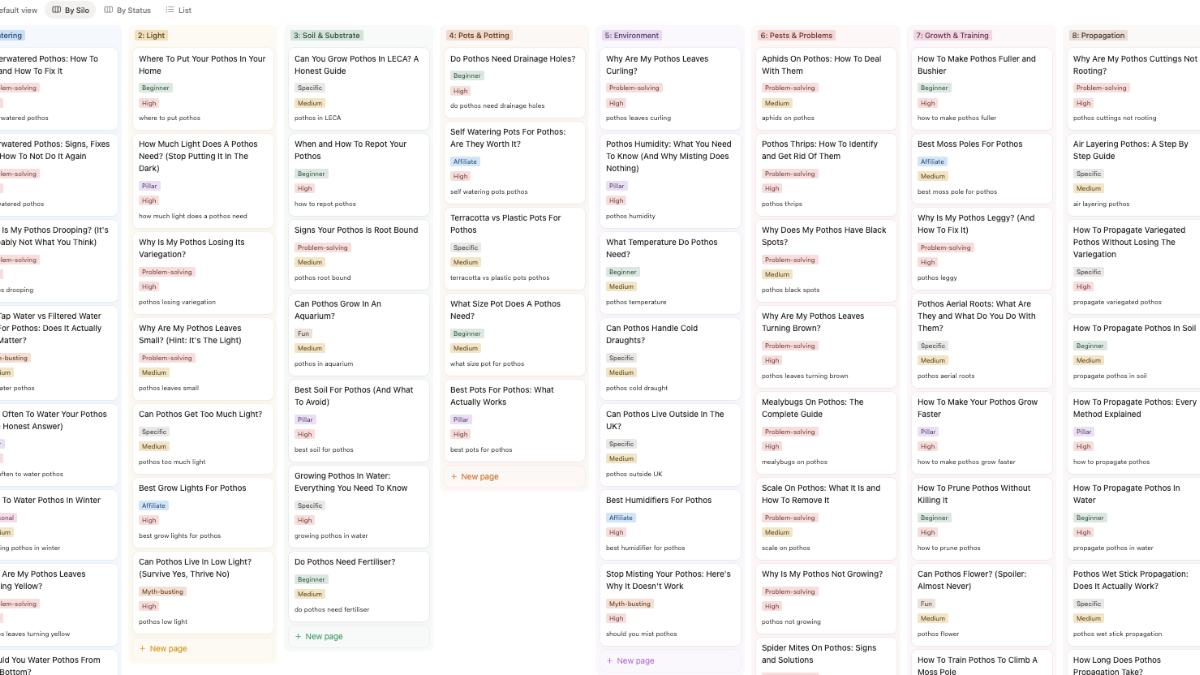
I’m trusting that you won’t steal this. If I was less lazy than I am, I would make a fake one and show you that. Maybe this is a fake, secretly rubbish one? How would you know?
On we move.
Pillar posts and supporting posts
Not all 60 articles are equal. Some are pillar posts — the big, comprehensive guides that anchor a topic area and that everything else links back to. Most are supporting posts — specific, focused articles that cover one question or subtopic in depth.
A simple way to think about it: your pillar post on pothos care covers the full picture. Your supporting posts answer the specific questions that a reader of that pillar post might have next. “How often should I water my pothos?” “What’s the best soil mix for pothos?” “Why are my pothos leaves turning yellow?” Each of those is a supporting post. Together they form a cluster.
When you’re planning your content matrix, identify one pillar post per category. Everything else in that category is a supporting post that links to it. The pillar post links back out to its supporting posts. This internal linking structure is what tells Google your site has depth on a topic, not just breadth — and it’s what helps individual posts rank better than they would in isolation. Article 46: How to Use Internal Linking to Boost Your Blog Traffic goes into this in more detail.
If you’re wondering, I’m definitely regretting numbering my articles. Never mind.
Which articles to write first
Once the matrix is built, the question becomes: where do I start?
A few principles that help here:
Write what you know best first. The articles you can write fastest and most confidently are the ones where your expertise is clearest. Those tend to also be the ones with the strongest EEAT signals — your own experience, your own voice, your own examples. Start there.
Don’t save the pillar posts for last. It’s tempting to build up to them, but pillar posts are what your other articles link to. If you write 15 supporting posts before the pillar exists, none of those internal links are doing anything yet. Write at least a draft of each pillar post early, even if you come back to expand it later. That being said, there is evidence that writing rankable content first is better for spreading link juice BUT you can always republish the article to a new URL later once you’ve got some traction.
Mix easy and hard. Some articles will take an hour. Some will take a day. Alternating between them keeps momentum going and stops any single article from becoming a blocker that pauses everything else.
Don’t write to the calendar. I don’t use a content calendar and I’d gently suggest you consider whether you need one either. A calendar tells you when you should have published — which is only useful if you actually hit the dates, and most people don’t, because life happens. What’s more useful is knowing exactly what your next article is, so that whenever you sit down to write, you can start immediately. That clarity is worth more than any schedule.
A realistic publishing cadence
How often should you publish? The true answer is: as often as you can sustain without the quality dropping.
The blogging advice that says you need to publish three times a week is not wrong exactly, but it’s aimed at people who write very short posts very quickly, and it tends to lead to thin content that doesn’t rank. One thorough, well-researched article a week will outperform three rushed ones almost every time.
For someone with a full-time job and a family, one article a week may not be realistic either. One article every two weeks, written well, published consistently, is a perfectly viable path. Twelve months of that gives you 26 articles — not 60, but a meaningful start. I personally love to work in sprints, but I work a 9-5 and don’t have kids.
The advice you’ll often hear is that consistency matters more than frequency — that a steady one-post-a-week rhythm beats bursts of activity followed by quiet periods. I’m not convinced that’s true in practice, either for Google or for you personally.
Google doesn’t reward publishing schedules; it rewards content that gets crawled, indexed, and matched to searches. Ten solid articles published in one productive fortnight count exactly as much as ten articles published one per week across ten weeks. Write when you have the time and energy to write well. If that means a quiet month followed by a burst of five articles, that’s fine. The matrix tells you what to write next whenever you’re ready — and that’s all you need.
I have a weird batching method we’ll cover in another article, which can mean I publish a lot in one go and then nothing for weeks. It’s fine.
Article 31: How to Batch Write Blog Content covers a practical approach to producing more content in less time, which changes the cadence calculation considerably.
This stuff is:
- INCREDIBLY DIFFERENT FROM PERSON TO PERSON. What works for me may horrify you.
- Will 100% change over time. It doesn’t matter. I promise.
What to do when you fall behind
No, we’re not falling for that one. There’s no such thing as falling behind. Blogging isn’t dead and never will be.
You might publish ten articles in a month and then nothing for six months. You might disappear for a year. You might go off and start a completely different blog in a different niche.
All of that is fine (ask me how I know 👀).
Blogging is not a gym membership that expires if you don’t use it (hosting is, but that’s besides the point). A well-written, evergreen article about why pothos leaves turn yellow is just as useful and just as findable in eighteen months as it is the day you publish it. Google doesn’t penalise gaps. Your content doesn’t decay. The work you’ve already done stays done.
Who knows? We’re all just a Google update from millionaire status (and obscurity. But that’s what keeps this interesting!)
The only thing that matters when you do sit back down is knowing where you left off and what comes next. That’s what the content matrix is for. Open it, find the next article marked not started, and begin. No catching up required, no explanation owed to anyone, no need to publish an “I’m back!” post that nobody was waiting for.
If you went off and built a second blog in a different niche in the meantime, that’s not a failure. Now you have two blogs. Both have content matrices. Both will grow whenever you give them attention.
The plan doesn’t care how long you were away. It just shows you what’s next.
The content plan in practice: what this looks like
To make this concrete: here is roughly what the planning process looks like from the beginning.
Week 1: brainstorm 60 article ideas, group into categories, identify pillar posts. Don’t open a keyword tool yet — this should come from your head first.
Week 2: run each idea through basic keyword research (Article 21 covers this step by step). Find the best keyword angle for each article and update the matrix. Cut any ideas that have no search demand and replace them.
Week 3: write article one. While you’re writing, notice what questions come up that could be their own articles. Add them to the matrix.
Repeat. Update the matrix as you go. Let it evolve as you learn what’s working and what isn’t.
The matrix is a living document, not a contract. Change it when you learn something new. What it shouldn’t become is a source of anxiety or a list of things you feel bad about not having done yet. It’s a tool for clarity. Use it that way.
And on that note, you can also update crap blog posts. A popular query on Reddit is ‘how do i know when a blog post is finished?’, but they’re never finished if you don’t want them to be.
Frequently asked questions
How many blog posts do I need before I launch?
Get the idea of a “launch” out of your head. Unless you already have an audience waiting somewhere, publishing your first blog post is less of a launch and more of a note slipped under a door that nobody is standing near. It will not be found. Nobody is refreshing Google waiting for your site to appear.
Write an article. Publish it. Write the next one. This is not YouTube, where an algorithm might serve your first video to ten thousand people. Search traffic builds slowly, from multiple articles, over months. The first post is just the first brick — it doesn’t need an occasion.
Do I need a content calendar for my blog?
Not necessarily. A content calendar is useful if you’re publishing on a fixed schedule and need to coordinate with other people. For a solo blogger, knowing your next article and having a plan for all future articles is usually more practical than a calendar full of dates you may or may not hit.
What is a content matrix for a blog?
A content matrix is a structured document that maps out all the articles you plan to write, along with the key information for each one: keyword, category, word count target, meta description, and internal linking plan. It’s the difference between knowing roughly what you want to write and having a clear, organised plan for how your whole site fits together.
How do I prioritise which blog posts to write first?
Write the topics you know best first, get at least a draft of your pillar posts done early, and alternate between longer and shorter articles to keep momentum. Don’t leave your pillar posts until last — your other articles need something to link to.
What should a blog content plan include?
At minimum: all your planned article titles, the primary keyword for each, which category each belongs to, the relationship between pillar posts and supporting posts, perhaps a status tracker. Add meta descriptions, word count targets, and internal link maps as you go.
What to read next
If you haven’t built your article idea list yet, How to Come Up With Blog Post Ideas That People Actually Search For is the place to start before you open a planning document.
Once you know what to write and in what order, Article 26: How to Write a Blog Post That Ranks on Google covers how to structure each post so it actually does the job.